SHORELINE: Around the Island of Martha’s Vineyard
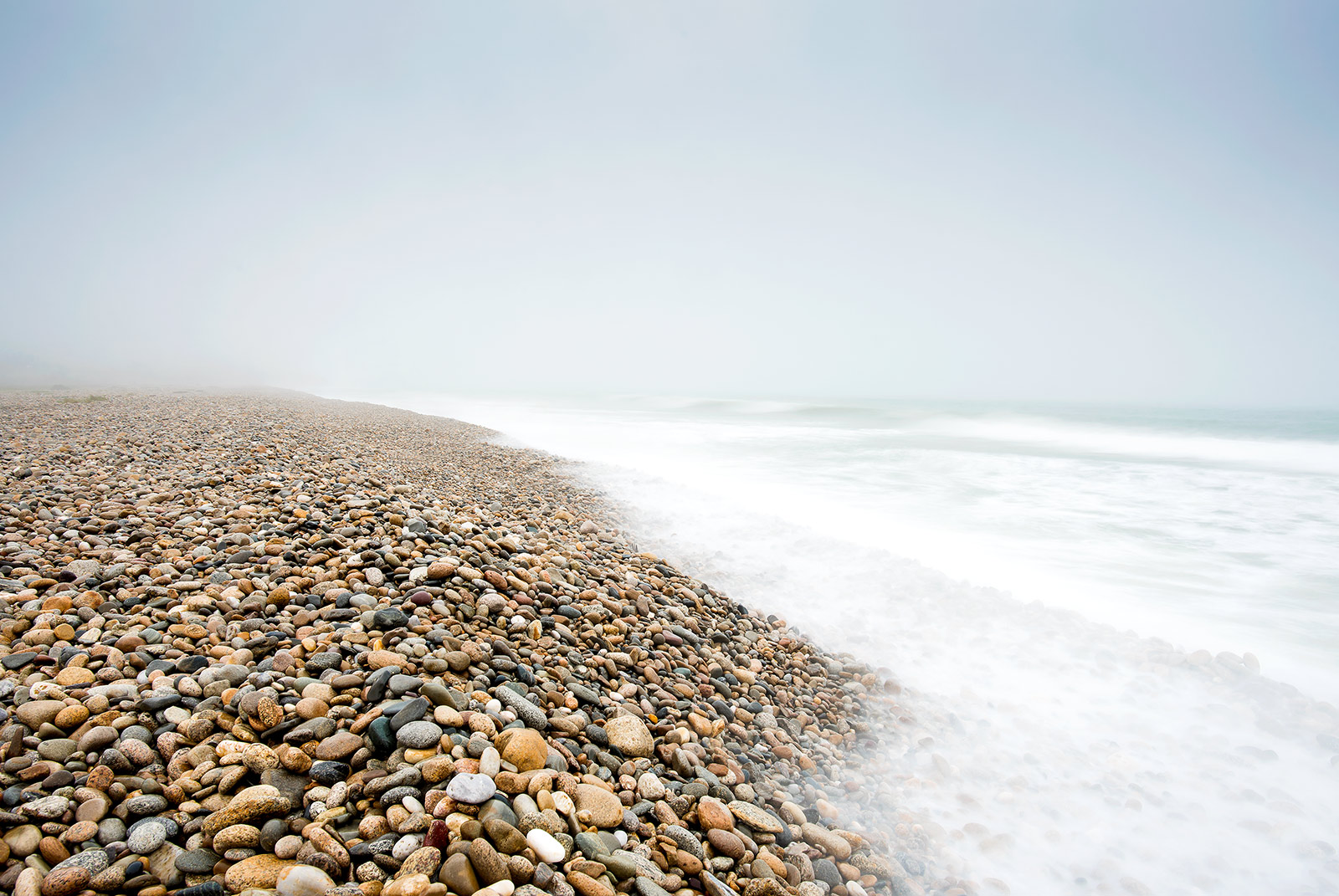
StonewallBeach2017

by Alison Shaw (and Sue Dawson)

HAVING MARTHA’S VINEYARD as my primary subject matter for more than 40 years certainly comes with many rewards, but also with its share of challenges. In the years that I’ve spent photographing these 100 square miles, I’ve constantly had to push myself to see the island anew. And sometimes I struggle to maintain my inspiration, creativity, momentum, and stamina, to keep shooting the same place for so long. If I lived in “America” I could simply go to the next town in search of new subject matter. Actually, I do go off-island to re-energize and shoot in other locations, and it does help. But I still have my one heart- and soul-touching muse – my island home.

So when I need to re-group, I remember one of my favorite quotes, from Marcel Proust: “The true voyage of discovery lies not in seeing new landscapes, but in having new eyes.” It’s not about finding a new environment, as fun and adventurous as that can be. It’s about finding something within myself.
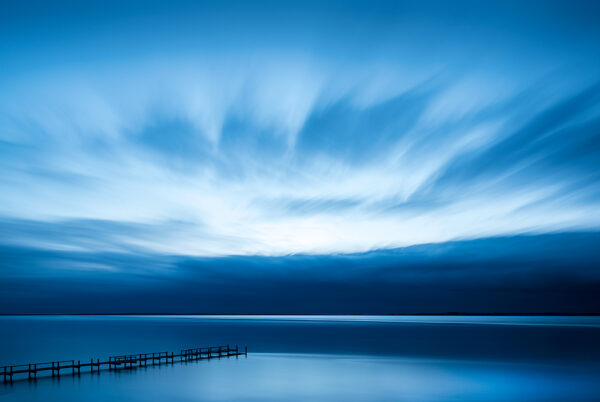
BigPierWestChop2017

Sometimes this means exploring a particular facet of the island more deeply. The search keeps me engaged and motivated. I love pursuing a project, which forces parameters, gives me structure, and organizes my thoughts. Recent projects have included photographing inside the wooden boat building shop at Gannon and Benjamin, in the studios of island artists, or documenting the island’s lighthouses.

In retrospect, seeing the island in new ways is not limited to the subjects I choose to shoot, but how I choose to shoot it. Over the years, my style has evolved dramatically. Going from black & white to color around 1990 was like trading in a box of charcoals for a set of oil paints – it felt like having an entirely new island to photograph. Fifteen years ago, I developed a new technique, where I move my camera as I shoot, creating more painterly images. In my most recent stylistic evolution, I moved from a super-saturated color palette to soft pastels and neutrals.

My most recent project has been photographing the shoreline of Martha’s Vineyard. This may seem like an obvious subject to choose, since I’m naturally drawn to the shore, and rarely photograph the inland vistas of the Island. But as much as I’m drawn to the Vineyard’s coastline, I get into the rut of returning to the same spots, looking for variations in weather rather than location. In 2014, I was obsessed with the new Fishing Pier in Oak Bluffs, and every time there was thick fog, stormy seas, or blizzard conditions, that’s where I’d go. In 2015, I was obsessed with the stone jetty between Inkwell and Pay Beach. I’d look out my window, see the condition was flat calm, and head for that one spot.
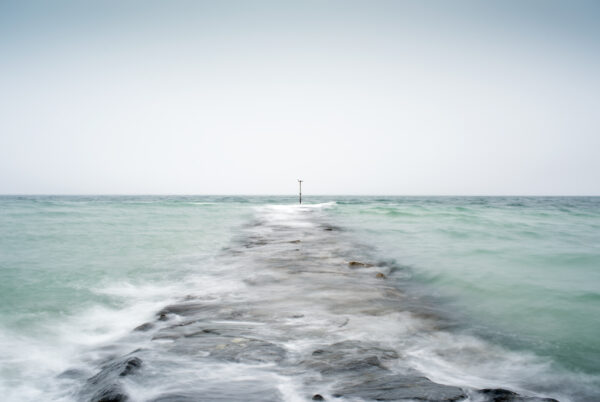
JettyPayBeach2017

Returning to these same locations over and over, as much as I enjoyed it both personally and artistically, clearly had its limitations. And then it occurred to me: The last time I’d photographed at Makonikey, on the North Shore of the island, was in my “high-impact-color-sunrise-sunset” phase in the early 90’s, using my clunky Pentax medium-format film camera. The same was true of Big Pier on West Chop, which I’d last shot for the Vineyard Gazette in the late 80’s, with my 35mm Nikon and black & white Tri-X film. Ditto Lambert’s Cove, Stonewall Beach, Katama Bay, Tashmoo Beach, and so on. Not to mention the many locations on the Vineyard shoreline that I’d never even laid eyes on before.

At first this idea just sat and percolated – I hate to admit it, but I let it stew for at least a year. There was definitely a good amount of inertia at work here… the urge to turn my alarm clock off, to spend far too much time planted in front of my computer, and to sit at home with a cat on my lap. The “just do it” mantra I had always tried to instill in my kids simply wasn’t working for me. Ok, we did move – that was a big deal, after being in the same house for 29 years. I spent lots of time picking paint colors with Sue (she calls us “color nerds”), going to the thrift shop every day looking for just the right end tables, and coming up with a garden plan.
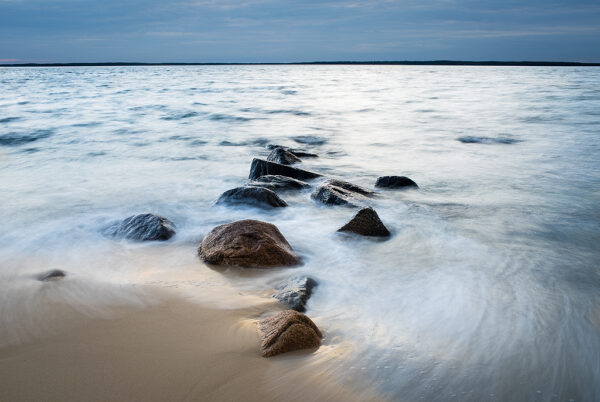
LambertsCove2017

Eventually, once we got settled in the new place, my inspiration kicked in – and when it did, I became a woman on a mission. The fire was lit. I decided to photograph the entire shoreline of the Vineyard – one rocky shore, one beach, one sunrise, and one sunset at a time.

My first steps were all about planning. I picked up a couple of excellent Island maps at the Land Bank office in Edgartown, and began figuring out access via conservation areas. Then I went on google maps in satellite view, and began examining the perimeter of the island, step-by-step, picking out large rocks and lone docks. I studied the tide charts – some scenes would be better shot at high tide, while others would be better at low (not to mention the fact that high tide could often present a challenge for navigating my way around rocky points on the North Shore). Sunrise and sunset times, in addition to the phases of the moon, all figured into the equation.
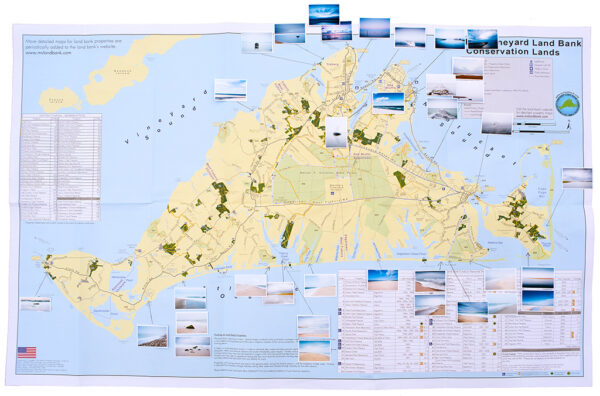
Shoreline Map.blog

As to weather conditions, once upon a time I might have been looking for what I considered to be “perfect” conditions for photography. But these days, I’m much more willing to go with the flow, a philosophy I developed during the course of teaching countless week-long workshops on the island. I used to agonize over picking the most promising mornings to meet up early. But these days I schedule a sunrise shoot for every morning of a workshop, and let my students know that unless it’s pouring rain, I will be there at the assigned location, in the pitch dark, waiting for them. The weather is fickle in New England, and that’s a good thing. I’ve grown to love never quite knowing when it’s going to be a good morning for photography. Another of my favorite quotes is from Woody Allen and is tacked to the wall over my desk: “90 percent of success is showing up.”
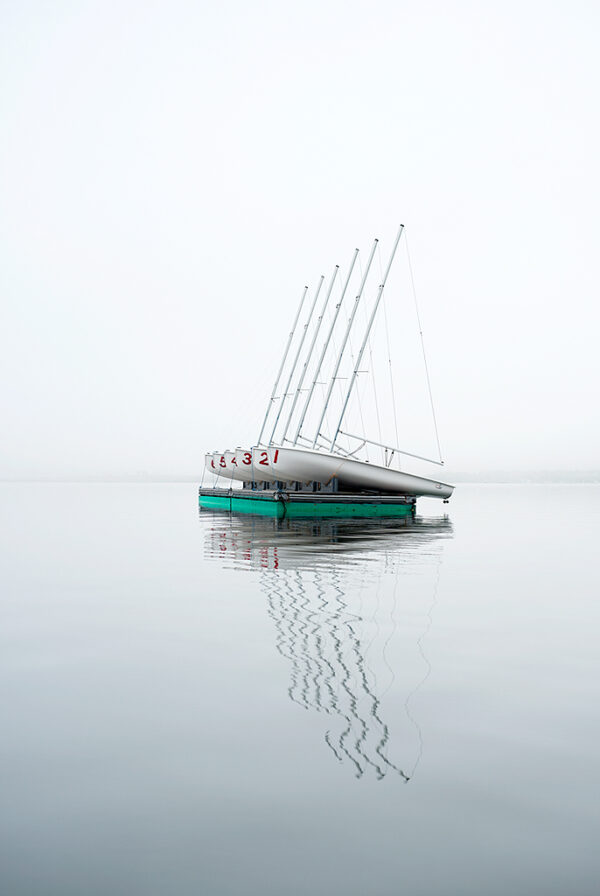
LagoonIII2015

Over the past six months of shooting for this project, I’ve often arrived home long after dark, with my sneakers full of sand and my tripod in need of a hose-down. When I set my alarm early, I actually go out and shoot – or even better, I rely on my internal alarm clock, which has served me well when I’m truly engaged in the prospect of my early morning photo expeditions. I’ve discovered both rocks and docks that I never knew existed. And I’ve been out there for magical moments of light and weather I would have otherwise missed.

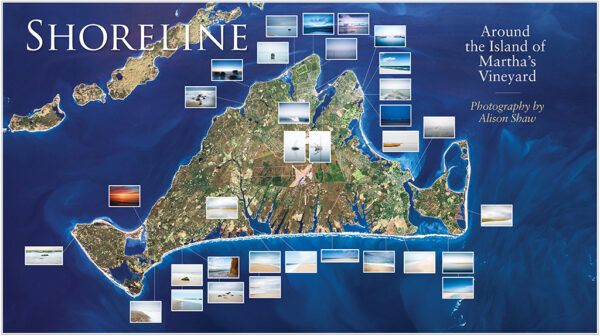
We are introducing over 30 new images from Shoreline: Around the Island of Martha’s Vineyard (©2017 Alison Shaw) at Alison Shaw Gallery this summer, with a whole new group I just hung on the walls for our Arts District Stroll tomorrow, 4-7pm. Inspired by my working map, Sue created a snazzy one in Photoshop, so you can see where each photo was taken (there’s a big version at the gallery).
Print

It’s become increasingly clear to me that there is so much more to this subject than I originally anticipated. There’s plenty of walking, kayaking and shooting still to come, so be sure to look for more images in the years ahead.

2022-05-27T22:07:21+00:00August 4th, 2017|8 Comments

Join us on Saturday: Book launch & PARTY

by Alison Shaw

I JUST DUSTED OFF some old binders of medium-format transparencies, did a little digging, made a few calculations, and realized I’ve been photographing the work of stonemason Lew French for nearly 25 years. Wow, talk about time flying. In the course of those 25 years Lew and I have spent countless hours together, traveled many thousands of miles to photograph his work, completed two book projects, and he even built a wonderful beach stone fireplace in our old Farm Pond house.

I’m proud to announce the launch of our second book together, Sticks and Stones, at our gallery this Saturday, August 65:00-7:00pm. Lew and I will be there to meet you and sign books.

Our first book together, Stone by Design, was published in 2007. Every single photo was shot on Martha’s Vineyard, where Lew had created all of his master stonework and gardens. Nearly 35,000 copies sold, and the book really put him on the map as not just a craftsman, but as an artist. CBS Sunday Morning did a fabulous segment about Lew, he’s been piling up awards and honors for his work, and he now has fans all over the world.

As a result, Lew’s not just a Martha’s Vineyard stonemason anymore. His well-deserved reputation has far exceeded the shores of the Island. So the stonework that graces the pages of Sticks and Stones took us to places like Brazil, the Adirondacks, Maine, Washington DC, Cape Cod and Boston.

My most memorable trip for this book was, without a doubt, my trip to Brazil in January 2015. I left the Island in near-zero temperatures, and photographed “sea smoke” on the ferry trip across Vineyard Sound  (caused by frigid air meeting slightly warmer water).

Sue captured Alison’s adventure shooting “sea smoke” in frigid weather, on her way to Brazil in January 2015. There’s even an appearance by Chris Morse, owner of the Granary Gallery, who took some photos of his own. (CW: language)

When I got to Brazil 24 hours later… well… let’s just say that Brazil in January is hotter than anything we can even imagine here on the island. After picking up provisions from a market in a remote small village, we headed many miles up into the mountains on a deeply-rutted, tortuously-bumpy red dirt road. We finally arrived at Lew’s home, nestled in a valley, at the base of thousands of acres of Brazilian rainforest. Lew built the home he shares with wife Claudia, and has created stunning stonework and lush gardens on their property.
 

Alison shot this video with her iPhone in January 2015, in Brazil, where she took photos of Lew and Claudia’s house for Sticks & Stones

The next four days were spent rising early and pretty much devoting the entire day to photography. I worked hard to capture the wild and dramatic setting of the house, the massive interior stone wall and fireplace, the many unique features of the home (including his own version of the traditional stucco and stone wood-fired cookstove), and even furnishings which Lew crafted of wood and stone.

In whatever down-time we had, it was much too oppressively hot to hike up the mountains and into the rainforest, but it was just the right temperature for an occasional shower beneath the waterfall on Lew’s property. We ate fruit I’ve never even heard of before, from some of the thousands of fruit trees Lew planted on the land. Geckos and other critters skittered through the house in search of a cool place to hang out. Wild horses ran in the distance, and monkeys chattered at dusk, far up in the mountains. At night I was grateful for the mosquito netting that surrounded my bed. “No, Alison, you’re not on Martha’s Vineyard anymore….”

Five days later (far too soon) I did the whole trip in reverse. It was a heck of a lot easier getting down the mountain that it had been going up. That is, it was easier until I got back to the winter temperatures I’d left less than a week before. That transition was a little rough, I must admit.

Please join us this Saturday for our book signing, and to celebrate our 10th anniversary season of Alison Shaw Gallery. Sue and I are very blessed to own this gallery together, and we want to share our celebration with you.
2022-06-04T15:22:02+00:00August 2nd, 2016|2 Comments

Behind the shot: A stormy winter

by Alison Shaw

Eastville 2013

THIS WINTER WAS FANTASTIC for photographing storms on the Vineyard. Anytime there’s a storm in the forecast, everything in my life comes to a screeching halt so I can focus on shooting. Once the storm is close to its peak, I leave my cozy home and happily head out into the elements, telling my family I’ll be back once the storm subsides or the sun goes down. The ones I particularly enjoyed shooting were Hurricane Sandy in late October, which was downgraded to a tropical storm by the time it reached us but nonetheless packed a powerful punch; winter storm Nemo in early February; and a March nor’easter. Sandy, in particular, was quite exciting, because there were really humongous waves and powerful winds, and it actually rearranged some of the shoreline of the Vineyard. I noticed this most dramatically at Lucy Vincent Beach, where the waves literally scoured all the sand off the beach, leaving rugged clay and stone exposed underneath. As it turned out, it wasn’t just the day of Sandy that was exciting – I continued to visit Lucy Vincent a couple times a week for several weeks. Each time it was different, often dramatically so. The big cliff at the end was weakened by the storm, and kept changing with the tides, until it finally collapsed into the sea.

With Nemo, I took a photo of Menemsha Harbor crusted in snow, the fishing boats and shacks covered in snow and ice, and a dramatic sky overhead. Earlier that day my car had gotten stuck in a snowdrift for the first time ever. Even though there wasn’t a lot of snow, the wind was creating significant drifts. I always foolishly plow through them, but this time didn’t work so well. Another car got stuck at the same time. I walked home through the snow to get a shovel, then hiked back to my car near Ocean Park to shovel it out. Total fail. Then, luckily, a guy with a large bucket-loader came to our rescue and pulled the cars out.

The March nor’easter brought high seas, spitting snow and rain, and strong winds. It was during this storm that I photographed the dock (top photo) at Eastville Beach – or what was left of the beach. What makes this shot unusual and compelling is that you’re not grounded by seeing the beach at all. In normal, non-storm conditions, the beach is very much in evidence. Here, the dock is isolated within the water – it’s a dock from nowhere, to nowhere.

To shoot this photo, I parked my car as close to the dock as I could, and planted my heavy tripod on the beach. I positioned my body to block the snow and wind from the lens, and took repeated exposures of 2 to 6 seconds, while the waves crashed over and through the dock and pilings. I chose a slow shutter speed to create the misty effect, caused by the motion of the waves. The bright reflection down the middle of the dock was caused by water sweeping over the dock as the waves broke, the wet wood reflecting the color of the gray sky. I stayed out in the frigid, windy, wet elements as long as my camera and I could bear it, and then took refuge in my car to warm up. Once my camera and glasses were dry (I keep a bunch of old white t-shirts in my car for this purpose), and I had feeling back in my fingers, I headed back out on the beach for another 5-minute stint. I pretty much repeated that process until the wind settled down a bit, making the conditions less ideal. One of the things I love about the resulting photo is the composition – the dock creates a strong line, leading your eye directly to the tip of West Chop in the distance.

We’ve just printed this image on canvas – big – and hung it on the main wall for the new show at Alison Shaw Gallery. Sue picked a deep blue-gray for the wall, to match the tones in the photo. The Arts District Stroll is tomorrow night (Saturday, July 13th), from 4 to 7pm – come by if you’re on the island.

2022-05-28T18:36:57+00:00July 13th, 2013|5 Comments

Building a whaleboat

by Alison Shaw

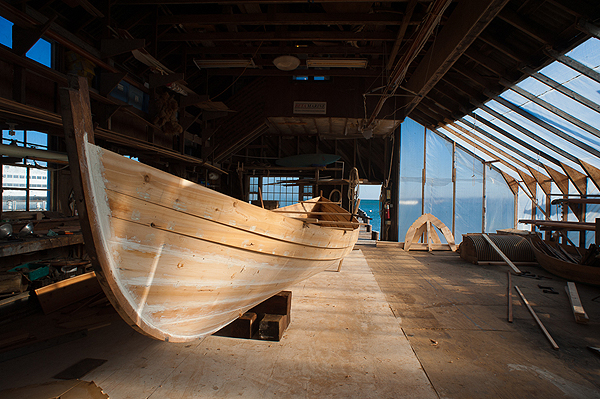
I’M CLOSE TO COMPLETING a new project chronicling the construction of a whaleboat for the Charles W. Morgan, America’s last surviving wooden whaleship, at Gannon and Benjamin Boat Yard in Vineyard Haven. This past December I happened to wander into the boatshed on the harbor, and casually asked what they were working on. When Nat Benjamin said “a whaleboat,” I could hardly believe my ears. A whaleboat?

My timing couldn’t have been better, since work on the boat had only just begun, and the only visible signs of it were a bunch of lines and markings (otherwise known as lofting) on the floor of the shed, as well as the beginnings of what would comprise the backbone of the whaleboat. I knew, without a moment’s hesitation, that I had to document this project.

I have a long history of photographing boatbuilding projects at Gannon and Benjamin, dating back to 1995-96 when I photographed the construction of the 24-foot wooden sloop Maybe Baby for Bill Graham of West Tisbury. Two years later I began photographing the construction of the 60-foot schooner Rebecca, which took nearly four years to complete. In 2010, we produced the book Schooner about the process, which was written by Tom Dunlop, designed by my partner Sue, and published by Vineyard Stories. It never occurred to me that yet another boat building project at Gannon and Benjamin would ever capture my imagination, to the extent that I couldn’t resist starting the photographic process over again.

So why this passion of mine for a whaleboat in particular? It probably goes back to my first job as an 11-year-old summer kid in Edgartown. I remember my grandparents taking me to the Dukes County Historical Society and introducing me to Margaret Chatterton, Director of the society. She hired me to work the lunch shift at the Thomas Cooke House – my job was to give tours of the house to visitors, so I had to become familiar with the contents of the house and the history of the island. One of my favorite rooms in the Cooke House was the one devoted to the whaling history of the Vineyard. Among other things, there was a model of a Nantucket sleighride, portraits of serious looking whaling masters, a big hunk of baleen, an elaborate sailor’s valentine, and a tribute to the wives and children who also went to sea. My interest in whaling carried on through my many summers of working at the museum, followed by a “real” job as their archivist after graduating from college.

Back to the story of the Charles W. Morgan and the building of a whaleboat. What makes the Morgan so important is that it is the last surviving wooden whale ship from the great days of whaling. She’s also the oldest American commercial vessel still in existence, and in 1967 was designated a National Historic Landmark. And what makes the Morgan so interesting to me as a Vineyarder are its many connections to the island. The Morgan was built in New Bedford in 1841 by the Hillman family, who were originally from Chilmark. She made 37 voyages, under the command of 20 different captains, before retiring in 1921. Seven of her masters hailed from the Vineyard, including her last, Captain George Fred Tilton of Chilmark, who served as her port captain. Since 1941 she has been on display and open to the public at Mystic Seaport. The Morgan has been undergoing a complete multimillion restoration begun in the fall of 2008, and is scheduled to be re-launched in July of this year. What will be her 38th voyage is scheduled for 2014, and includes visits to historic New England ports including Vineyard Haven!

The Morgan will be carrying seven whaleboats. Each of these seven boats is being privately funded and built by one of seven different boat builders. Gannon and Benjamin Boat Yard, not surprisingly, was invited to build one of the whaleboats.

Ginny Jones at G&B kindly kept me up to date on both the progress of the whaleboat as well as filling me in on the history of the Morgan. She reported that Captain Bob Douglas, master of the topsail schooner Shenandoah, was inquiring as to what kind of whaleboat they were building. Apparently, it is patterned on the many whaleboats built by the Beetle Company in New Bedford. Bob noted that the company had not just patterns, but piles of pre-cut spare parts. This meant that in the heyday of whaling, if someone asked for a whaleboat, a team could build one in a day!

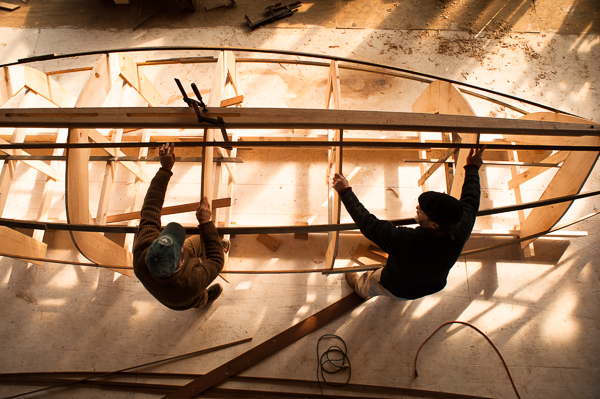
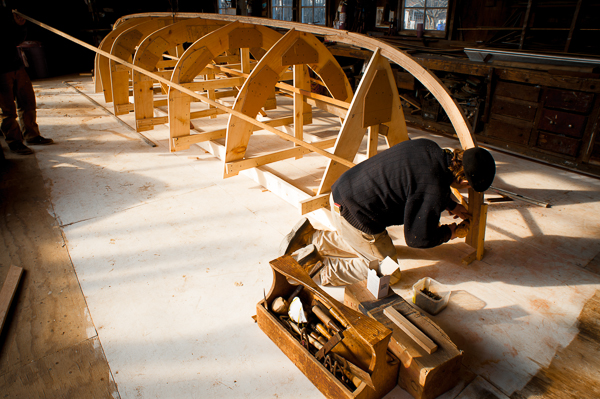
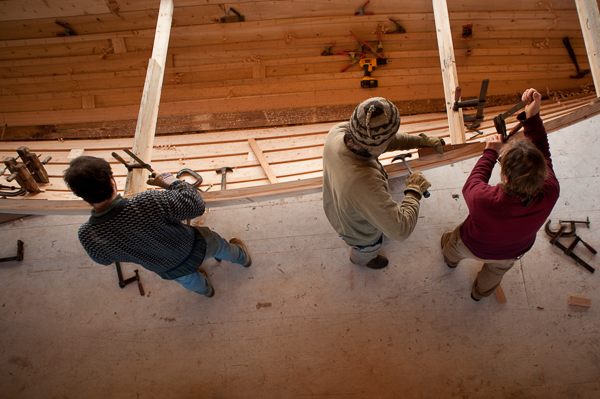
As for the photos, my self-assigned job has been to document the process, and bring my own visual aesthetic to the photos. I couldn’t ask for better raw material to work with – the wood, the fittings, the tools and the cluttered setting of the boat building shed on the harbor. Not to mention that the boat builders themselves look like they could be from central casting, with their rugged good looks, hand-knit fishermens’ sweaters, and well-worn work boots and gloves (thank you in particular to Nat Benjamin, and young Nat Quinn). The lines of the whaleboat as it evolved are sturdy and utilitarian, yet classic and graceful. The outer shed where the boat was built is enclosed on one side by translucent plastic, so it’s like being inside a huge soft box – plenty of beautiful light. Then, inside the inner sanctum of the shop, it’s dark with aged wood punctuated by vintage machinery and an old woodstove. It’s lit with a few bare bulbs and some strong directional light pouring through a single window on the east side of the building – just gorgeous, making my job easy.
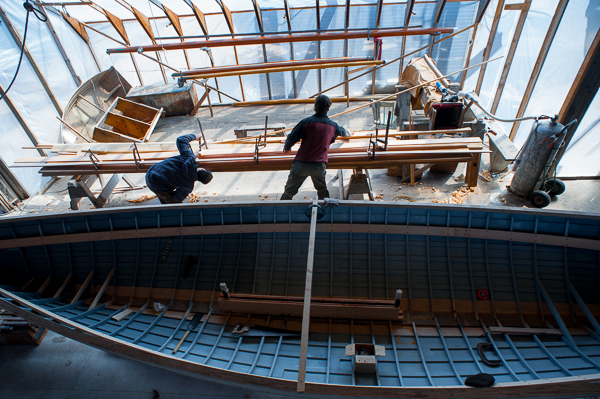
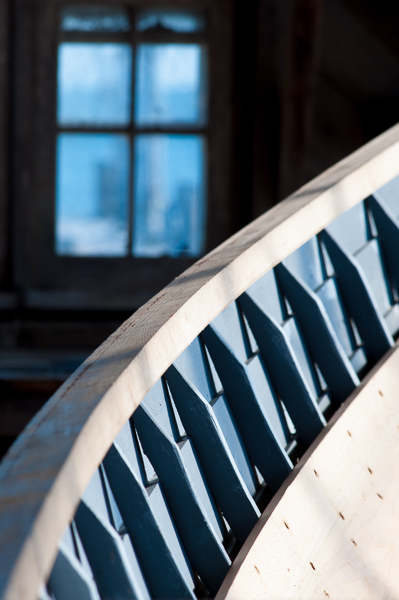
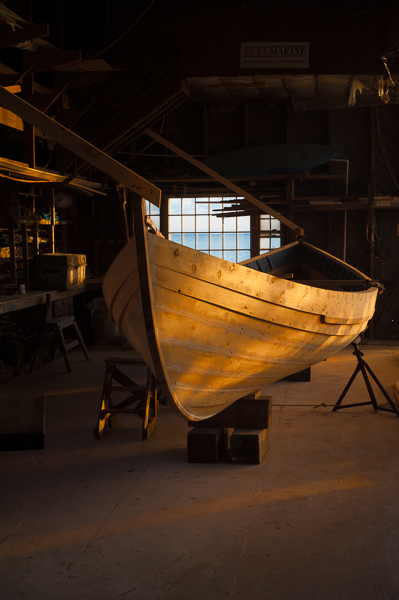
All that’s left to do are a few odds and ends and perhaps a final coat of paint. The launch is scheduled for Saturday, June 15, 2013 at 4pm. Not long after, she’ll be on her way to Mystic in time for the Wooden Boat Show the end of June. The story of her construction, launch, and journey to her new home on-board the Charles W. Morgan, will be published in Martha’s Vineyard Magazine, along with a story by long-time collaborator Tom Dunlop.

2022-05-28T18:55:10+00:00May 21st, 2013|7 Comments

September workshop on Martha’s Vineyard

by Alison Shaw

I JUST FINISHED TEACHING my September workshop (otherwise known as “photo boot camp”) on the Vineyard. It was a great and talented group of sixteen students, my trusty assistant Donna Foster, and our “shadow” Jonathan Hart, a Vermont-based photographer who spent the week observing.

DAY 1, Sunday:
7pm: Meet-and-greet session at the Mansion House, fueled by Chilmark Chocolates and red wine. Jen Sayre broke her own record for the most Alison Shaw MV workshops – she’s taken six workshops with me on the island since 2003. She gets re-inspired each time, and we love having her.

DAY 2, Monday:
5:30am – We met at Owen Park Beach in the pitch dark. Most students were unsure how to use their cameras in daylight, much less in total darkness. Among other things they contended with: finding coffee at 5am; shooting on “Manual” for the first time in years; learning what shutter speed “Bulb” represents; realizing that Auto-focus doesn’t work in the dark; and discovering that overcast conditions at dawn produce blue photos.

4:30pm – Headed for Lucy Vincent Beach via the Granary Gallery. When we arrived at the beach I couldn’t believe my eyes – there were the biggest waves I’d seen at that beach since the “No-Name” storm of October 1991.  Normally I don’t shoot much on workshops, since I’m too busy helping my students. In this instance I simply couldn’t resist getting my camera out and I photographed for a couple of hours, trying unsuccessfully to stay clear of fast-moving waves, and periodically stopping to answer questions and offer photo tips. Most of my advice concerned deciding whether to freeze a crashing wave with a fast shutter speed, or to let the water go silky smooth with a slow shutter speed. We departed the beach at nightfall, wet but happy.

Henry Olds at Lucy Vincent Beach

Ben Linsky at Lucy Vincent Beach

DAY 3, Tuesday:
5:30am – Edgartown Lighthouse was our destination on the second morning. The Derby fishermen arriving in their pickup trucks at 6am were miffed to find all of their parking spaces taken by a bunch of out-of-state SUVs. The best view of the lighthouse was from across Eel Pond, the lighthouse silhouetted against the dawn sky, and the shutter timed perfectly to capture the red light in the lighthouse. Harold Green discovered for the first time the intense orange of the dawn sky juxtaposed against the brilliant deep blue of the water – he was grinning from ear to ear as if he’d won the lottery, and didn’t seem to mind the fact that he’d only been getting about five hours of sleep a night.

Mid-day – Each day for the rest of the week, mid-morning to mid-afternoon was spent in the classroom editing and critiquing the day’s images. I love this part of the day, since I am often so amazed by some of the photos my students have created – things that I never saw, or never would have dreamed up myself. It’s incredibly inspiring and definitely jump-starts my own creative juices if I’m in a rut. I believe in the old adage that a teacher learns as much from his/her students as vice versa. My critiquing tools of choice are my cropping angles and my laser pointer. I must have used my cropping tools for one out of three images on Day 1 of critiquing – the lesson students learn is that they’ve often got a picture within their picture, so they need to come in closer to their subject in order to extract the final image.

4:30pm – Sunset at Menemsha. It was the first time I’d seen the devastation caused by the dramatic early summer fire that destroyed the Coast Guard boathouse, dock and several boats. It was lucky the wind wasn’t blowing in the opposite direction at the time, thus sparing all of the fishing shacks and my favorite picturesque fishing boat, the “Little Lady.” Menemsha is a tricky location to photograph since there is so much STUFF everywhere you look. I always encourage my students to leave their gear in the car and spend a lot of time just looking before they even think about taking their first shot. A mini-tailgate party of smoked bluefish and white wine gave them enough sustenance to keep shooting until dark, an impressive feat considering the hours we’ve been keeping.

DAY 4, Wednesday:
5:30am – We returned to Lucy Vincent Beach for sunrise. During a workshop, I love going to this location for both a late afternoon and an early morning shoot – it’s like discovering an entirely new beach. Actually, the more you go back to the same location again and again the more you realize that the conditions are ALWAYS different – that the weather, the wind, the clouds, the humidity, the tide, the night sky, and light never ever repeat themselves exactly. Even if the conditions are close to the same, it’s the fine art photographer’s job to create a new photo out of the same raw material. I’ve been photographing Lucy Vincent Beach since the late 1970s, and each time I try to interpret it differently.

4:30pm – For a change of pace, and in case anyone was feeling “beached out,” we visited the Farm Institute at Katama Farm in Edgartown. This is a working educational farm, with just the right amount of grit, and chock full of a multitude of farm animals who either ran for cover or posed for our cameras. Jim Linsky captured two of the weirdest and yet most successfully creative animal photos I’ve ever seen, by using an interesting vantage point and crop, in conjunction with a fish-eye lens.

Katama Farm Turkeys by Jim Linsky

Katama Sheep by Jim Linsky

DAY 5, Thursday:
5:30am – I tried my best to convince everyone that they really ought to take the morning off, but to no avail – this was one seriously hard-core group. So we met in the dark, as usual. There were a few skunks determined to befriend us, but we finally convinced them to go bother some bird watchers instead. We shot the full moon as it set behind the bandstand in Ocean Park. Funny, you usually hear about the rising of the full moon rather than the setting – maybe it’s because most people are still sound asleep at this hour.

3pm – We visited the Alison Shaw Gallery in the Arts District of Oak Bluffs, where my partner and co-gallery owner Sue Dawson made everyone feel welcome and studio manager Claire Cain introduced them to the mysterious inner workings of the upstairs studio. Then back to the Mansion House to meet individually with students – this is a great time to address specific questions and topics, since I have each student set their own agenda for our meetings. While I was in the classroom, I sent the rest of them out to shoot on their own, but I’m guessing there was a lot of napping and/or shopping (just kidding) going on as well.

DAY 6, Friday:
5:40am (I let them sleep in a little since the sun is rising a few minutes later every day now. . . .) – We met on the beach in front of the Black Dog Tavern, in time to see the 6am ferry Nantucket pull out of its slip. Vineyard Haven Harbor is usually a pretty sheltered early morning location, but we were dealing with an overabundance of wind all week. The same wind that made for dramatic conditions at Lucy Vincent Beach made for more challenging conditions on the harbor – for one thing, wind pretty much kills the dreamy reflections of boats and docks. Once the sun reached the horizon we gravitated towards the Gannon and Benjamin Boat Yard and photographed the boatbuilding shed. Our early morning shoots culminate in an excursion to one of my favorite breakfast spots, in this case the Artcliff Diner. We always manage to eat like truck drivers after our long mornings of shooting.

5pm – Friday evening was time to kick back and enjoy the fruits of our labor, and abandon shorts, t-shirts and sneakers in favor of more fashionable attire. Our social hour and dinner at Zephrus was followed by the Friday Night Show, which celebrates the best of the week’s work. Donna put together a great show, complete with soundtrack, and we even had a few guests to cheer us on. It’s a real high seeing my students’ work on the big screen.

DAY 7, Saturday:
9am (how civilized!) – We met at the Farmers’ Market in West Tisbury, which was as much a morning of socializing and wolfing down eggrolls and popovers, as it was of shooting. Our farmers’ market has to be one of the most picturesque anywhere in the country, and the vendors are incredibly tolerant of my little flock of photographers – as soon as the tripods appear they know I won’t be far behind. The workshop ended back at the Mansion House, with lots of hugs, a few tears, and promises to keep taking photos and to stay in touch.

POST-WORKSHOP:
Terry Wiechman began an email thread that has kept the group connected, and Andy Nixon created a Flickr group for the September workshop. Go team! And I finished the week so jazzed that I was possessed by the desire to blog. It’s a little embarrassing, since my blog has lain dormant since one feeble entry in April 2009. And no, I haven’t been out shooting like I promised. But then again, I do have a book to write and an October workshop to prepare for, so I’ve got a good excuse, right?


2022-05-28T19:33:02+00:00September 30th, 2010|0 Comments

Behind the shot: The “swimmer” series

by Alison Shaw

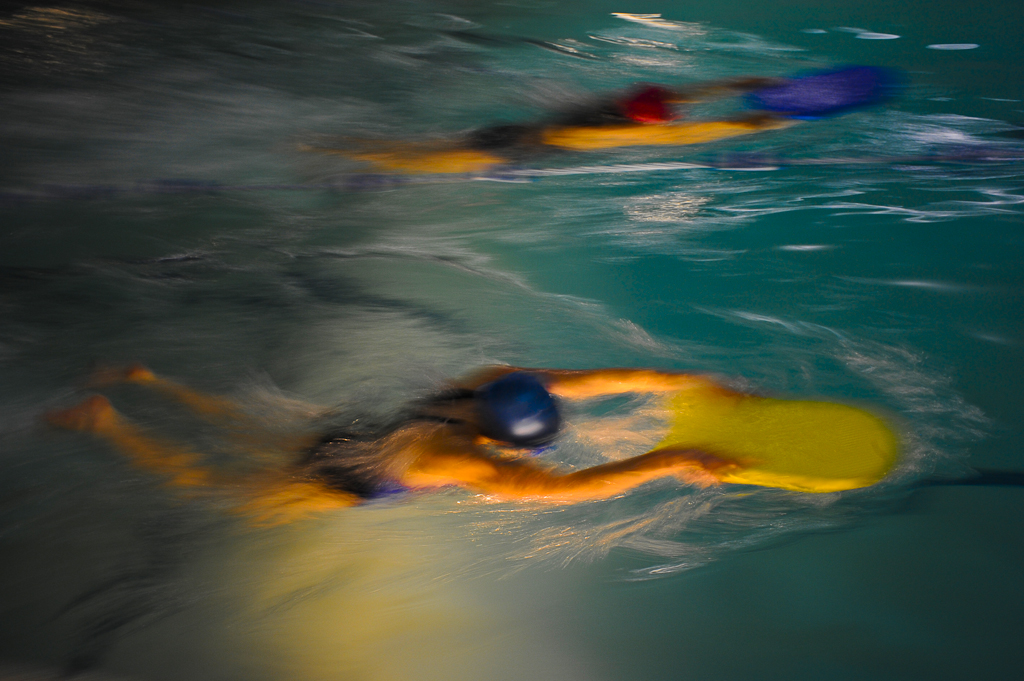
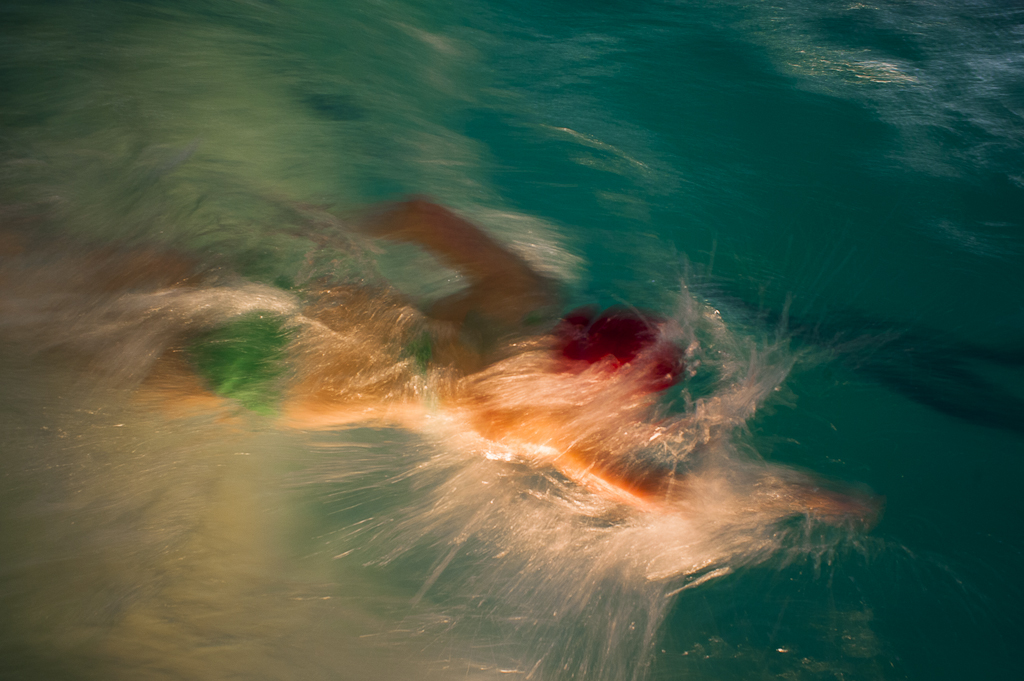
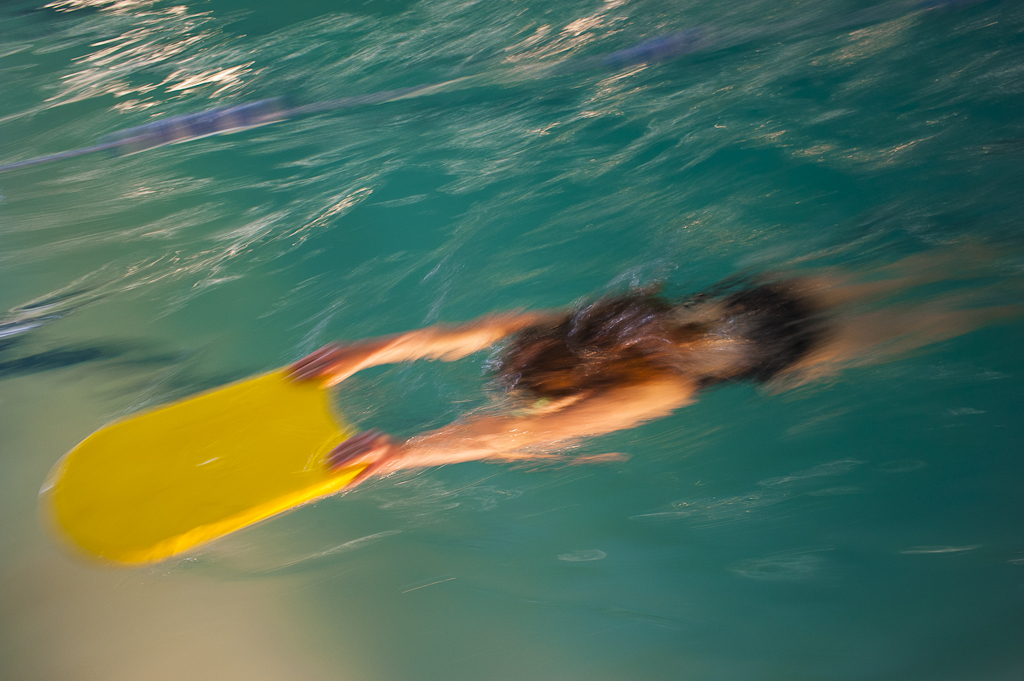
I’VE BEEN WORKING ON A NEW SERIES of photos of “Swimmers” at our local indoor pool. Truthfully, it started out as something I could do to pass the time while my daughter Sarah swam with the swim team each week, while I, otherwise known as “Mom’s taxi service,” waited until it was time to transport her back home.

It wasn’t long before the snapshots I thought of as entertainment turned into work I really cared about, as I filled up at least one memory card each Thursday afternoon, and headed back to my studio to download the images and tweak them a little in Lightroom.

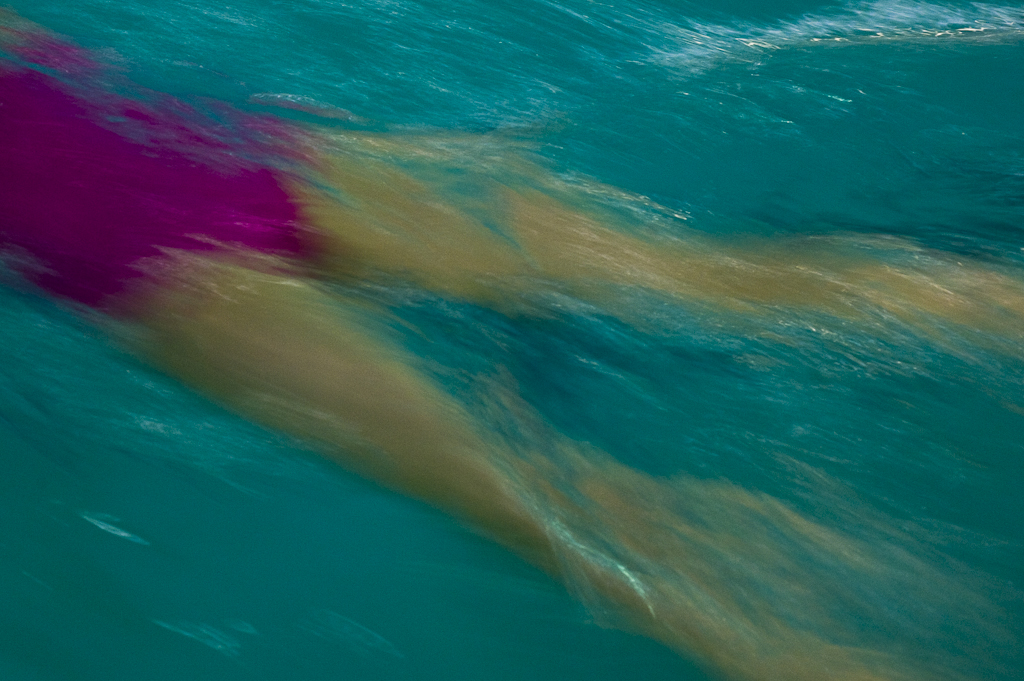
I’ve been playing a lot with motion photos over the past few years, most recently starting to use my camera like a paintbrush, and “sketching” or “painting” with my camera. In the case of Sarah and her teammates on the swim team, I panned them with the camera as they swam past me, using a slow shutter speed to intentionally try to pick up the sense of motion, while simultaneously abstracting the images to a certain degree. I’m always trying to capture the “essence,” rather than the literal fact of whatever I might be photographing – this was true in the case of the swimmers.

There’s no doubt that Sarah (who, by the way, is an excellent swimmer) had to put up with a lot of silliness and demands from her mom, but after all these years I think she’s used to that. These include but were not limited to:

  • making her arrive at the pool a half hour early so that my lens had adequate time to de-fog.
  • making her squeeze into a hot pink bathing suit that was two sizes too small for her.
  • making her borrow a swim cap from her instructor, since her own cap was covered with distracting logos.
  • signing her up for a second session of swim team – this time it can be a “business expense.” And by the way, the same is true of the brightly-colored swim caps and kickboards I’m ordering on-line …

2022-05-28T19:40:05+00:00April 2nd, 2009|0 Comments

Title

Go to Top